Exploring the Possibilities of Western Hemlock: Interview with Furniture Designer Alison Littman
We recently spoke with furniture designer Alison Littman about her experience designing two unique furniture pieces—an armoire and a console—using Western Hemlock. With a background in industrial design and decades of experience working with manufacturers across North America and Southeast Asia, Littman brings a deeply hands-on, production-savvy design perspective to furniture fabrication. She shares how working with Western Hemlock challenged her assumptions about softwoods, how texture and finish played a central role in the design concept, and how Western Hemlock can support both high-design expression and production realities—from hand-worked detail to scalable, machined texture.
Can you start by sharing a bit about your background and how you came to focus on furniture design?
I studied industrial design and entered the furniture industry through store fixtures and interior environments. Early on, I learned the most by working directly with manufacturers—building prototypes, testing ideas quickly, and understanding how things actually get made.
Over time, that evolved into designing full furniture lines, exhibiting at trade shows like High Point and ICFF, and doing custom design-build work for hospitality, retail, and residential projects. Eventually, international sourcing became part of my work when a manufacturing partner moved operations to Vietnam, which really expanded my understanding of how material choice, process, and factory capabilities all intersect.
Before this project, what was your perception of softwoods in furniture—did working with Western Hemlock change that?
Absolutely. Being introduced to Western Hemlock really opened my eyes. Once I saw the range of finishes, grain expression, and performance, it immediately triggered the designer part of my brain: What else can this material do? What became exciting wasn’t just how it looked, but how it could be pushed—especially texturally—to align with where furniture trends are heading.
What initially drove the design direction for the armoire and console?
Texture was the big driver. There’s a strong trend right now toward tactile surfaces—chiseling, carving, wire-brushing—details that add depth and a sense of craftsmanship. Western Hemlock took color beautifully, which was already compelling, but I wanted to take it a step further by contrasting smooth, finished surfaces with areas of texture. The idea was to show how a softwood like Western Hemlock could feel elevated, contemporary, and relevant—not rustic or expected.
“The finish range was incredibly inspiring. It has just as much flexibility as commonly used woods like ash, oak, or maple—if not more. From a design perspective, that opens up a lot of creative freedom: you’re not locked into one look, and the wood responds consistently whether you go light, dark, refined, or textured.”
How did Western Hemlock perform from a design and finishing standpoint?
The finish range was incredibly inspiring. Seeing the finish wall at the Canadian Wood showroom really drove home how versatile this species is. It has just as much flexibility as commonly used woods like ash, oak, or maple—if not more. From a design perspective, that opens up a lot of creative freedom. You’re not locked into one look. You can go light, dark, refined, or textured, and the wood responds consistently.
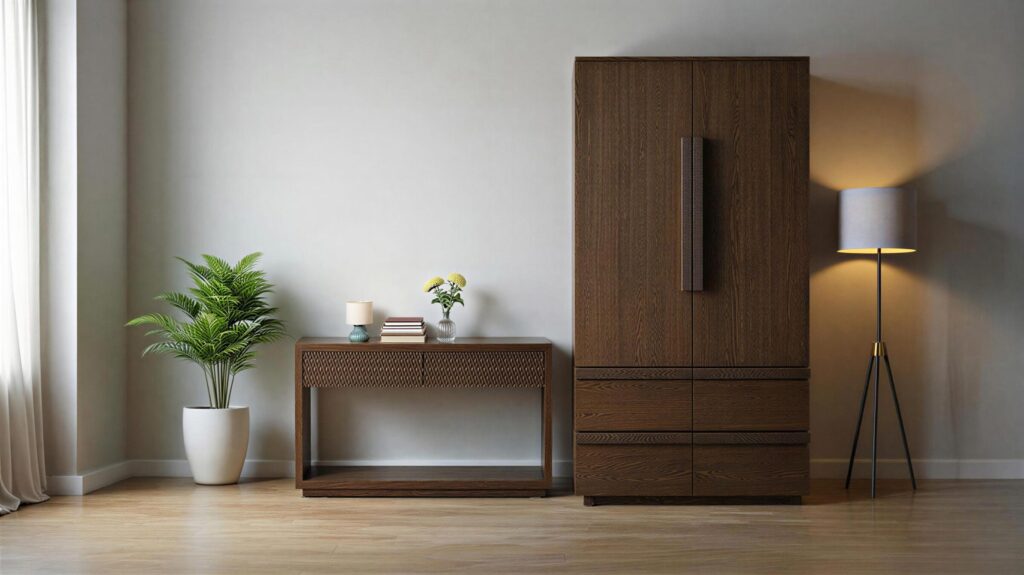
The armoire features hand-chiseled detailing—how did that process unfold with the manufacturer?
There was some troubleshooting required, but I knew the wood—and the factory—were capable of achieving the look. I shared visual references, videos, and examples to help communicate the intent. It took persistence, but I wasn’t going to give up knowing the material could get there. In the end, the result really demonstrated both hand-crafted and machined possibilities, which was important to the story.
How did the console differ from the armoire in terms of production approach?
The console leans more into machined texture, driven by what CNC and production equipment can do efficiently. The armoire, on the other hand, showcases a more hand-worked feel. Together, they show a range—from artisanal to scalable—that manufacturers can relate to.
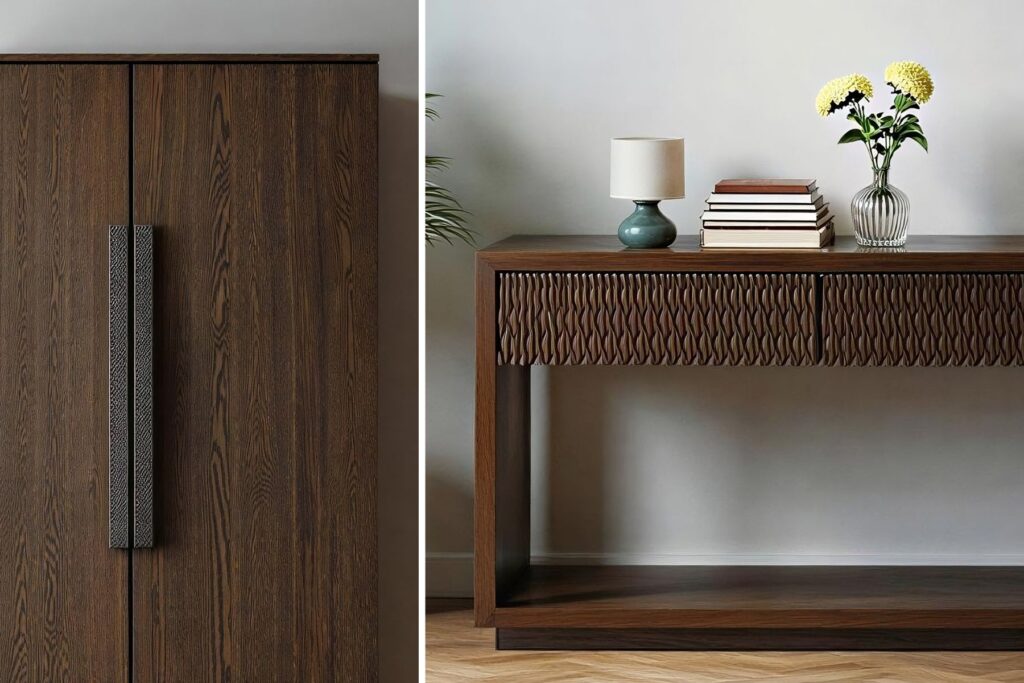
“Crafted from Western Hemlock—a species prized not only for its structural stability but also for its ability to accept finish with uncommon depth—these pieces exemplify how a humble wood can be elevated through texture, tone, and treatment.“
How does Western Hemlock’s price point factor into design decisions?
That’s a huge advantage. When you’re working with a wood that performs well but comes at a more accessible price point, it allows you to invest in other areas—like texture, detailing, or mixed techniques—without pushing the final piece out of reach. You get more bang for your buck, which is especially valuable right now as designers are layering more complexity into furniture.
What trends do you see shaping furniture design, and how does Western Hemlock fit into them?
There’s a strong move toward what I’d call refined naturalism—natural materials, but controlled within a contemporary framework. Less overtly rustic, more intentional and architectural. Sustainability also plays a big role, but only when it’s truly baked into a brand’s mission—not treated as an afterthought.
Do you see Western Hemlock becoming more widely used in furniture—and what do you think will drive that?
I’m hopeful it will. I think the more designers see what Western Hemlock can do—especially the range of finishes and the ability to take texture—the more naturally it will enter the design conversation. And as more manufacturers adopt it and begin showing real examples of what’s possible, it becomes easier for everyone to specify it with confidence.
What advice would you give designers who are curious about working with Western Hemlock?
Embrace it and experiment. It’s a new possibly less well-known material for designers, but that’s part of the opportunity. Push the material—through texture, finish, and form—and see where it takes you. What surprised me was how clearly design intent translated at the factory level once the process was dialed in. And starting small with prototypes or limited runs, it’s a low-risk way to learn what’s possible.
About Canadian Wood
Canadian Wood is part of Forestry Innovation Investment (FII), a Crown agency of the Government of British Columbia, headquartered in B.C., Canada, with satellite offices in Vietnam and India. Through market development programs, Canadian Wood promotes and supplies information about softwood products from British Columbia to wood industry professionals, and connects furniture manufacturers, designers, and wholesalers with leading softwood suppliers from B.C.
Try Canadian Wood
Looking for the right grade and wood species to achieve the desired design, color and appearance for your next project? To help you better understand the color and overall appearance of Canadian softwoods, Canadian Wood offers small wood samples for you to work with. Contact us to find out more.